A recent PiXL article asks a deceptively simple question:
If I have taught it, have they understood it, and how do I know?
It is worth sitting with that question, particularly before pupils reach Year 10.
PiXL’s argument focuses on a familiar challenge within Key Stage 3. Years 7, 8 and 9 sit between the nationally assessed end of primary education and the high-stakes qualifications that follow. With no equivalent national endpoint at KS3, schools carry considerable responsibility for deciding what successful progress through these years looks like and, importantly, what evidence is sufficient to show that learning has become secure.
The concern itself is not new. Ofsted’s 2015 Key stage 3: the wasted years? report called for schools to give greater priority to this phase, particularly by building more effectively on previous learning and improving the quality of assessment.
More than a decade later, the issue remains relevant. The Curriculum and Assessment Review, published in November 2025, again placed emphasis on curriculum coherence, depth and strong foundations. The government’s subsequent response also signalled renewed attention to assessment during KS3, including plans for a statutory Year 8 reading assessment and a stronger emphasis on formative assessment in maths and writing.
There is clearly an important conversation taking place about what pupils know during Key Stage 3.
Learning Readiness gives us a way of extending it.
From “Have they learned it?” to “What can they now do with it?”
Within Long Game Learning, Learning Readiness is defined as:
The developing capacity of people to engage with learning, apply knowledge, respond to challenge, adapt to change and continue developing across contexts and stages of life.
At the heart of this definition is the recognition that learning depends upon knowledge. There can be no meaningful application without something sufficiently well understood to apply.
Yet recall alone cannot tell us everything we need to know about learning. A pupil may remember a method or reproduce an explanation successfully while remaining unsure about when that knowledge is relevant. They may manage confidently while a task resembles previous practice, only to struggle when its surface features change.
Application therefore matters, although it should not be separated from the knowledge that makes application possible. Pupils also encounter difficulty, uncertainty and unfamiliarity as learning becomes more demanding. Their developing capacity to respond to those situations, reconsider an approach and continue learning becomes increasingly significant.
Seen in this way, Year 9 is not valuable simply because it precedes Year 10. What has been developed across KS3 should leave pupils increasingly capable of engaging with what follows.
This is where the PiXL argument and Learning Readiness begin to intersect.
The question is not simply whether important knowledge has been encountered. It is whether pupils have developed a secure enough understanding to recognise its relevance and make meaningful use of it.
When performance can hide insecurity
The examples raised by PiXL illustrate the problem well.
In mathematics, a pupil may reproduce a procedure accurately when the question makes the required method obvious. The difficulty only becomes visible when several approaches are possible and the pupil must decide which one fits.
Science can reveal something similar. A pupil who explains a concept confidently in isolation may struggle when asked to use that understanding to account for an unfamiliar observation.
An English teacher might see sophisticated writing about a text that has been studied extensively, followed by far greater uncertainty when the pupil encounters something unseen.
It would be too simplistic to conclude that these pupils know nothing. Their difficulty may lie elsewhere. Relevant knowledge may exist, yet not be sufficiently connected for them to recognise when to draw upon it. In other cases, pupils may not know how to begin independently or how to change direction when their first approach proves unsuccessful.
This is one reason transfer deserves careful treatment. Research has long suggested that transfer to unfamiliar situations cannot simply be assumed. It is influenced by what pupils already know, how securely that knowledge has been organised and the kinds of opportunities they have had to use it beyond the conditions in which it was originally taught.
That point also guards against a different problem: presenting transferable skills as if they operate separately from disciplinary knowledge.
Learning Readiness does not suggest that a pupil can acquire a generic form of “problem solving” that functions identically in algebra and literary analysis. Successful performance remains shaped by what the learner understands about the particular domain.
What becomes interesting, then, is the relationship between secure knowledge and the learner’s growing capacity to use it well.
What should KS3 assessment actually tell us?
If this distinction matters, assessment at KS3 needs to reveal more than whether pupils can reproduce something taught recently.
That does not require another layer of high-stakes testing. In fact, filling the space left by the absence of national KS3 examinations with repeated internal examinations could leave the underlying question untouched.
Different forms of evidence tell us different things.
There are occasions when teachers need to establish whether essential knowledge can be retrieved accurately after time has passed. Elsewhere, the more revealing task may require pupils to connect ideas or determine for themselves which previous learning might help with an unfamiliar problem.
Sometimes the evidence sits in the explanation rather than the final answer. Asking a pupil why they chose an approach, or what they might change after encountering difficulty, can reveal aspects of understanding that the completed task alone cannot show.
This also matters because learning should not remain something understood only by the teacher.
Pupils can gradually become more capable of recognising what they know, noticing where their understanding is insecure and making informed choices about how to respond. The Education Endowment Foundation’s guidance on metacognition and self-regulated learning supports explicit teaching of processes such as planning, monitoring and evaluating learning, while emphasising that these should be developed through subject content rather than detached from it.
That is an important connection with Learning Readiness.
Identifying a gap is useful for a teacher. A longer-term educational aim is for the pupil to become increasingly able to recognise difficulty and respond with less dependence on external direction.
What PiXL’s argument brings into focus
One of the strongest features of the PiXL argument is its emphasis on seeing problems earlier.
When weaknesses in foundational knowledge become visible only through Year 11 mock examinations, the available response is inevitably constrained. Later learning frequently depends upon what came before it, so something that appears to be a small misconception in Year 7 can become increasingly consequential as the curriculum becomes more complex.
PiXL is also right to draw attention to the difference between knowing and applying. Assessment can sometimes create an impression of security because the task closely resembles previous teaching. Change the context, remove a familiar prompt or ask pupils to make the decision for themselves, and a different picture may emerge.
There is a leadership dimension here too. Individual teachers often hold a rich picture of the pupils they teach. Subject leaders need to understand whether patterns are emerging across classes and over time, while senior leaders face the additional challenge of seeing what is happening across different disciplines without stripping away the subject-specific detail that makes the information meaningful.
The difficulty is creating coherence without reducing curriculum quality to a collection of data points.
This tension is reflected within the Ready.Set.Life. curriculum audit developed through Long Game Learning. Its READY element considers whether knowledge has been coherently sequenced, whether assessment is revealing meaningful understanding and whether gaps are identified early enough to influence what happens next.
The SET element extends that enquiry into the use of learning. It considers whether pupils encounter opportunities to transfer and adapt what they know, including situations where the route to an answer has not already been signposted.
In that sense, Learning Readiness allows the conversation to move beyond whether the curriculum has been covered towards a richer consideration of what that curriculum is enabling pupils to become capable of.
More assessment is not automatically better assessment
There is, however, a danger in responding to the KS3 problem too quickly.
What can be measured most easily can begin to look like what matters most.
Diagnostic assessment can be extremely useful. It may reveal misconceptions that would otherwise remain hidden and allow teachers to intervene before they become more consequential.
It cannot, by itself, tell us whether somebody is fully “learning ready”.
Learning Readiness is a developing capacity rather than a score that can be captured at a single moment.
Two pupils achieving the same result may have reached it in very different ways. One may have strong knowledge but remain dependent on reassurance. Another may demonstrate independence but carry a misconception that will limit future progress. A pupil who succeeds in a familiar task may respond quite differently when the scaffolding disappears.
Treating those pupils as though they have the same educational need would lose precisely the information assessment is supposed to provide.
Workload matters here as well. Attempting to record every aspect of learning continuously could generate a considerable volume of information without improving the decisions teachers make. Data becomes useful when it changes something: what is revisited, how an explanation is adapted, where further practice is required or when pupils are ready to encounter greater complexity.
Perhaps the more productive question is therefore:
What evidence would genuinely change what we teach next?
That places assessment back inside curriculum thinking rather than allowing it to become an exercise in proving that teaching has occurred.
KS3 deserves to be more than preparation for GCSE
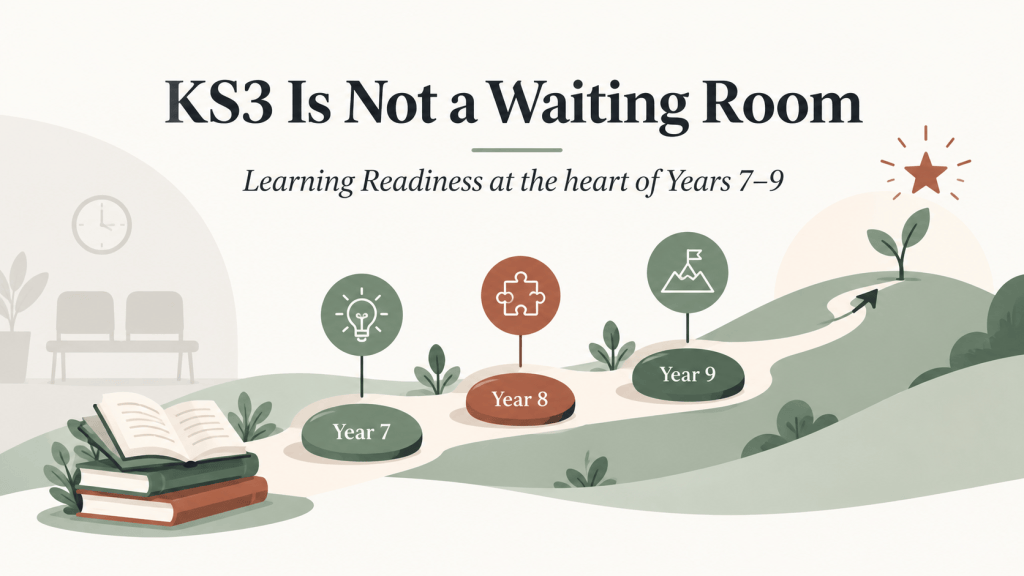
The “waiting room” metaphor raises a bigger question about what Key Stage 3 is actually for.
Preparing pupils well for GCSE study is clearly part of its purpose. There is no reason to diminish that.
The difficulty comes when future examination performance becomes the dominant lens through which Years 7 to 9 are understood.
These years represent a substantial period of development. Pupils encounter increasingly specialised disciplinary knowledge and begin to form stronger beliefs about the subjects they enjoy, understand or consider “for them”. Independence does not suddenly arrive when GCSE courses begin. Neither do effective learning habits.
Important decisions about future study also start to become real during this phase.
Mary Myatt has similarly argued in 2026 for KS3 to be understood as a significant educational phase in its own right, characterised by ambitious subject knowledge and intellectual development rather than treated primarily as preparation for examination courses.
Learning Readiness adds another dimension to that conversation because it asks what pupils are gradually becoming capable of through their experience of the curriculum.
A department may reasonably want to know whether pupils remember the important content they were taught. It might also ask whether pupils can make connections between earlier and current learning, particularly when those connections have not been made explicit for them.
What happens when the task becomes more difficult also matters. Some pupils persist intelligently, others repeat an unsuccessful strategy, while others disengage or immediately seek help. Those responses provide useful information about learning, although they should never be interpreted separately from the quality of teaching, available support or pupils’ existing knowledge.
The broader question therefore becomes:
What has studying our KS3 curriculum made pupils increasingly capable of doing?
This does not move us away from knowledge.
It makes the security and usefulness of that knowledge more important.
From coverage towards capability
Perhaps this is where the current KS3 conversation has its greatest potential.
Schools do not necessarily need more information about pupils. They need information that helps teachers and leaders make better decisions about learning.
Useful assessment can reveal what has become secure and where misconceptions continue to interfere with progress. It can also expose situations in which pupils appear successful while considerable dependence on familiar prompts or structures remains.
As learners develop, they should gradually play a greater role in recognising that information themselves.
This is where Learning Readiness becomes useful as a concept. It asks us to see learning as more than successful performance on the task immediately in front of a pupil.
The starting question may still be:
“Did they understand what we taught?”
What follows is less predictable.
Can they recognise when that knowledge is useful? What happens when the familiar route disappears? Do they have enough understanding to reconsider their approach when difficulty emerges? As expectations increase, are they becoming more capable of continuing without every next step being supplied for them?
Those questions take us beyond curriculum coverage while remaining firmly rooted in the importance of the curriculum itself.
KS3 is therefore far more than a waiting room for GCSE.
It is a period in which schools can deliberately strengthen the foundations on which later learning depends, while gradually increasing pupils’ capacity to work with what they know.
GCSE outcomes matter, of course.
The longer game is whether the education that precedes them leaves young people increasingly able to learn when the next lesson, qualification or teacher is no longer organising every step for them.
References
Education Endowment Foundation (2025). Metacognition and Self-Regulated Learning: Guidance Report. London: Education Endowment Foundation.
Hajian, S. (2019). Transfer of learning and teaching: A review of transfer theories and effective instructional practices. IAFOR Journal of Education, 7(1), 93–111.
Ofsted (2015). Key stage 3: the wasted years? Manchester: Ofsted.
PiXL (2026). KS3: The Waiting Room for GCSE. Published 21 September 2026.
Curriculum and Assessment Review (2025). Building a World-Class Curriculum for All: Final Report. Department for Education.
Myatt, M. (2026). KS3: The ambitious years: Why Years 7–9 matter more than we think. Mary Myatt Learning Limited.


Leave a Reply