What are we really preparing young people for?
Ask different people what education is for and you are likely to receive very different answers.
A parent might talk about qualifications and future opportunities. A pupil might talk about learning, friendships or getting a good job. A teacher might talk about knowledge, curiosity and intellectual development. A school leader might talk about academic outcomes, personal development, destinations and preparation for adulthood. All of these answers are valid. The difficulty begins when they stop being connected.
This is an increasingly important question within contemporary education. What should schools ultimately seek to achieve, and how can that purpose remain visible when education is experienced through individual lessons, subjects, assessments, qualifications, interventions, careers activities and enrichment?
Sammy Wright’s Exam Nation provides a powerful contemporary challenge to the way we answer this question. Wright examines what happens when examinations and grades become too closely associated with educational success. The issue is not that examinations have no value. Academic knowledge and qualifications matter. The problem emerges when the measure of an outcome begins to substitute for the purpose of education itself.
This is not a new philosophical question, but it is a pressing contemporary one.
Recent educational scholarship also explores whether the purposes of education can ever be reduced to a single outcome. Juvonen et al. (2024), revisiting Gert Biesta’s influential framework, describes three domains of educational purpose: qualification, socialisation and subjectification. Qualification concerns the knowledge, skills and capabilities education develops. Socialisation concerns how young people become part of existing social, cultural and professional worlds. Subjectification concerns the development of the individual as an increasingly autonomous person who can think and act within those worlds.
Murphy et al. (2025) similarly describe educational purpose as a complex and multidimensional “wicked problem”. Their analysis builds on Biesta’s three domains while exploring the different benefits and tensions associated with educational purpose across several education systems.
The significance for schools is profound. Perhaps the problem is not that education has too many purposes. Perhaps the problem is that we have become less effective at showing how those purposes belong together.
That is where Long Game Learning begins.
Education has more than one purpose
It is tempting to frame the debate as a choice.
- Should schools prioritise academic achievement or wellbeing?
- Knowledge or skills?
- Qualifications or employability?
- Individual development or preparation for society?
- Examinations or life beyond school?
The evidence and theory suggest that these are false choices.
Biesta’s framework is useful precisely because it resists reducing education to one function. Qualification, socialisation and subjectification describe different dimensions of what education does, while also creating tensions that educators have to navigate. Juvonen et al. (2024) argue that these purposes need to be understood in relation to one another, particularly in contexts where pressure for high-quality learning outcomes can cause other educational purposes to become sidelined.
This gives us a useful way of understanding the challenge.
A young person needs knowledge. They also need to understand how to use that knowledge. They need to participate with others, but also develop their own identity and agency. As much as you need to understand the world they are entering, they also need to be able to continue learning within it.
None of these purposes makes the others irrelevant. The difficulty is creating a coherent educational journey in which they reinforce one another.
That is the problem Long Game Learning is attempting to solve.
The problem is not exams. It is what we make them mean.
There is a danger in positioning Exam Nation as simply an argument against examinations.That would miss the more important point.
Examinations can provide valuable evidence of knowledge and attainment. Qualifications can open doors. Academic success can transform opportunities. The question is what happens when these outcomes become the dominant language through which educational success is understood.
A grade is visible but learning habits are less visible.
A qualification is visible yet growing independence is less visible.
A destination is visible, but the development of agency is less visible.
A result can be recorded. The capacity to respond to failure, adapt a strategy or continue learning is much harder to capture. This creates a particular challenge for schools. The things that are easiest to measure can gradually become the things that are easiest to prioritise. The wider purposes of education do not disappear, but they can become disconnected from the experience of schooling.
This is where the question of Learning Readiness becomes important.
Learning Readiness:
The learner behind the result
Our earlier Long Game Learning cornerstone article, What Is Learning Readiness?, began with a simple question: what does a young person need in order to learn effectively?
The term itself is used in different ways across educational research. It can refer to developmental readiness, readiness for a particular learning environment, self-directed learning or the capabilities required to engage successfully with learning.
Long Game Learning brings these ideas together through a broader definition:
Learning Readiness is the combination of knowledge, habits, behaviours, attitudes and strategies that enable individuals to learn effectively, over their lifetime.
This definition deliberately moves beyond the idea that readiness is something a pupil either has or does not have.
A child is not simply “ready”. They are developing readiness. A Year 6 pupil develops readiness for secondary school, while a Year 10 pupil develops readiness for independent examination study. A sixth-form student develops readiness for higher education or employment, but an apprentice develops readiness for increasingly complex professional responsibilities. The process continues throughout life.
This connects closely with research on self-regulated learning. Zimmerman (2002) describes self-regulated learners as active participants in their own learning who plan, monitor and evaluate their progress. Contemporary guidance from the Education Endowment Foundation similarly emphasises explicitly developing pupils’ ability to plan, monitor and evaluate learning within subject contexts.
Learning Readiness therefore asks something deeper than whether a pupil can complete today’s task. It asks whether we are developing a learner who is increasingly capable of managing the learning that comes next and that distinction matters.
If education is a journey, then the purpose cannot simply be to prepare pupils for the next assessment. We need to prepare them to keep learning.
From Learning Readiness to Ready. Set. Life.
This is where the architecture of Long Game Learning becomes important. Learning Readiness is the underlying proposition. Ready. Set. Life. is the architecture that makes it visible. The framework is built around a simple progression:
READY – Can I develop the foundations I need to learn effectively?
SET – Can I apply what I know with confidence, independence and purpose?
LIFE – Can I use what I have learned to navigate and contribute to life beyond school?
These are not three departments or three curriculum areas. They are definitely not three fixed stages that pupils complete once. They are three lenses through which schools can understand the development of the learner. This matters because the architecture reconnects purposes that can otherwise become fragmented.
Knowledge belongs within READY.
Application belongs within SET.
Future pathways belong within LIFE.
However, none of them exist independently. The learner moves through all three continuously.
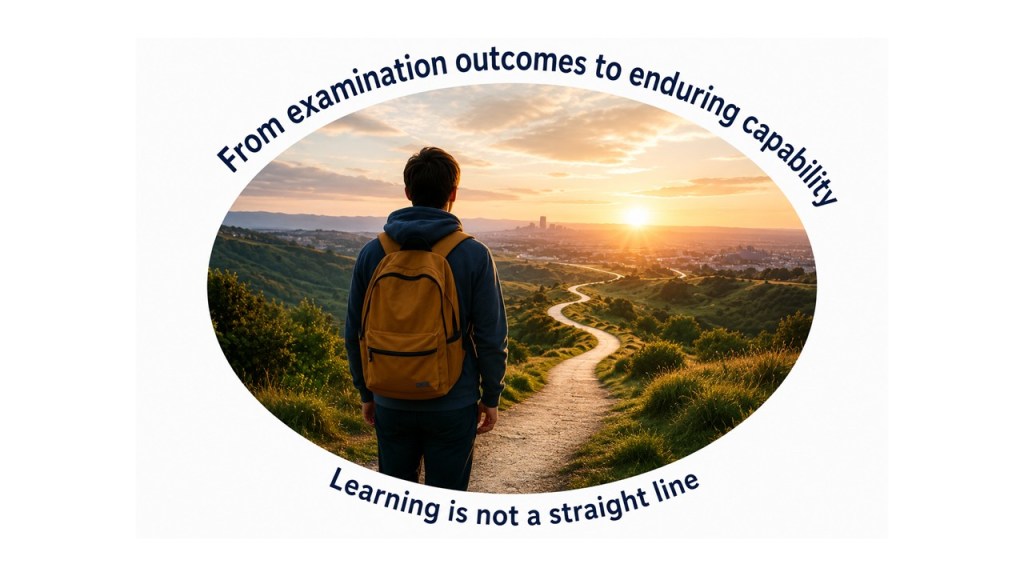
Learning is not a straight line
Learning is rarely a straight line from knowing to succeeding. It is tempting to imagine education as a progression. First, pupils develop the knowledge and habits they need. Then they apply what they know. Finally, they use those capabilities beyond school. This is broadly the journey represented by READY, SET, LIFE, but the reality of learning is much less linear.
Matthew Syed’s Black Box Thinking offers a useful way of understanding why. Syed argues that improvement depends upon being willing to examine outcomes, learn from mistakes and use evidence to change what happens next. Failure is not simply an endpoint. Properly understood, it becomes information.
This matters for Learning Readiness because being ready to learn does not mean being prepared for every challenge. It means having the knowledge, strategies, attitudes and behaviours to respond when something does not work.
A pupil may learn a strategy in READY, attempt to use it in SET, discover that it is not effective, receive feedback, reflect on what happened and adapt their approach. They may then return to READY to strengthen their understanding before trying again.
The process therefore looks less like a staircase:
READY → SET → LIFE
and more like a cycle:
Learn → Apply → Feedback → Reflect → Adapt → Learn again
READY, SET and LIFE are not stages that pupils complete and leave behind. They are interconnected dimensions of development. A young person may need to return to READY when they encounter something unfamiliar in SET. Experiences in LIFE can reveal new learning needs. Reflection on failure can strengthen future readiness. Application can expose gaps in knowledge that need to be addressed. In this sense, the architecture is developmental rather than linear.
It also changes how we think about failure. If the purpose of education is simply to produce the right answer, failure becomes evidence that something has gone wrong. If the purpose is to develop learners who can continue learning, failure can become part of the process through which capability develops.
This is where Syed’s thinking connects particularly well with metacognition and self-regulated learning. Effective learners do not simply complete tasks. They monitor their performance, interpret feedback, evaluate their approach and make adjustments. The capacity to do this is itself a form of Learning Readiness.
For schools, the same principle applies at a wider level. A curriculum, intervention or strategy should not be considered successful simply because it has been implemented. Schools need to examine the evidence of what happened, understand where pupils struggled, identify what helped and adapt provision accordingly.
The same cycle therefore operates at both levels:
The learner learns, applies, receives feedback and adapts.
The school implements, evaluates, learns and improves.
This creates an important connection between learner readiness and organisational learning.
Ready. Set. Life. is therefore not a staircase towards a fixed destination. It is an architecture for continuous development. Its purpose is not to move every learner neatly from one stage to the next, but to create the conditions in which they can repeatedly learn, apply, reflect and adapt as the demands of life change.
That may be one of the most important aspects of preparing young people for the long game. We cannot prepare them for every challenge they will encounter. We can, however, help them become increasingly capable of learning what they need next.
READY: Developing the foundations for learning
READY is where Learning Readiness becomes most tangible. It asks whether pupils are developing the knowledge, habits, behaviours, attitudes and strategies required to learn effectively.
That includes curriculum coherence, literacy, numeracy, executive function, self-regulation, metacognition, retrieval, memory, behaviour for learning, inclusion, SEND, belonging and wellbeing.
The important shift is that these are not treated as characteristics pupils should simply arrive with. If we want pupils to revise independently, we need to teach them how learning and memory work. If we want pupils to regulate their learning, we need to explicitly develop self-regulation. If we want pupils to reflect on their progress, we need to teach them how to monitor and evaluate their learning. If we want pupils to become increasingly independent, independence needs to be developed rather than assumed.
This is why Learning Readiness provides an important response to the concerns raised by Exam Nation.
It does not reduce academic ambition.
It asks what needs to sit beneath it.
Better examination performance can be an outcome of better learning.
But the purpose of developing a capable learner extends far beyond the examination.
SET: From knowing to applying
A learner who knows how to learn is not yet the finished product. They also need opportunities to use what they know.
SET therefore asks whether pupils can apply, transfer and adapt their learning.
The Long Game Learning audit looks for opportunities to apply skills beyond the lesson, develop critical thinking, practise deliberately, use a shared language of skills and build confidence in applying learning.
This is not a case of replacing knowledge with generic skills, as knowledge remains fundamental. A pupil cannot think critically about something they know nothing about. They cannot solve meaningful problems without knowledge, or communicate ideas effectively without something worth communicating.
The question is what happens once knowledge has been developed.
- Can the pupil use it?
- Can they transfer it?
- Can they explain their thinking?
- Can they adapt when the situation changes?
- Can they work with others?
- Can they make decisions?
- Can they recognise where else their learning might be useful?
SET therefore connects qualification with agency. It takes the learner from knowing towards doing.
LIFE: Giving learning a purpose
Then comes the question that examination results cannot fully answer.
What is all this learning for?
LIFE represents the long game.
It asks whether education is helping young people develop aspiration, purpose, resilience, wellbeing, future pathways, employability, relationships, citizenship, community and lifelong learning. This does not mean turning every lesson into a careers lesson. It means helping pupils understand that learning has significance beyond the immediate task.
A science lesson is about scientific knowledge, but it can also develop curiosity, evidence-based thinking and the ability to make informed decisions.
A history lesson develops historical understanding, but it can also help young people understand how societies change and how evidence shapes our interpretation of the world.
PE develops physical knowledge and performance, but it can also develop decision making, communication, resilience and collaboration.
The subject remains the subject. The wider purpose becomes visible through it. This is where the three parts of the architecture begin to work together.
READY asks whether the pupil can learn.
SET asks whether they can use what they learn.
LIFE asks what they might do with those capabilities.
Making the “why” of education visible
This may be one of the most important functions of Ready. Set. Life. Schools often have a very strong answer to the question “why?”. It may exist within the school’s vision, articulated in curriculum intent, careers strategy, or even show up in enrichment.
The problem is that the answer can become distributed across the system:
- A pupil experiences individual lessons.
- A parent experiences homework, reports, options evenings and examination results.
- A teacher experiences curriculum requirements, assessment and professional responsibilities.
- A leader experiences strategy, accountability and improvement priorities.
Everyone may be working towards the same broad purpose without having a shared language for seeing it. Ready. Set. Life. creates that language.
It allows the school to say:
We are developing young people who are READY to learn, SET to apply what they know and prepared for LIFE beyond school.
That is simple enough for a pupil to understand, clear enough for a parent to recognise, while being substantial enough to support professional discussion.
Ultimately, it provides leaders with a way to test whether different areas of school are contributing to the same purpose.
The Sinek connection: starting with why
This is where Simon Sinek provides a useful, although different, perspective.
Sinek’s Start with WHY argues that organisations and leaders are more effective when they begin with their purpose, cause or belief rather than simply communicating what they do. His Golden Circle places WHY at the centre, followed by HOW and WHAT.
Sinek is not an educational theorist, and his work should not be treated as equivalent to the educational literature on purpose. However, the principle is highly relevant. Schools are very good at communicating their WHAT.
- We teach mathematics.
- We deliver GCSEs.
- We provide careers education.
- We offer enrichment.
- We run assessments.
- We prepare pupils for examinations.
- We provide personal development.
Schools are generally good at saying HOW:
- We use explicit instruction
- We embed retrieval practice
- We adapt our teaching
- We use spaced practice and Interleaving for core concepts
- We ensure quality first teaching
- We provide one-to-one check ins
- We have safe havens for support
- We apply restoritive approaches
The question is whether pupils and parents can see the WHY that connects these things. Ready. Set. Life. offers one possible answer.
WHY – We are developing learners who can learn, apply learning and thrive.
HOW – Through the connected development represented by READY, SET and LIFE.
WHAT – Curriculum, teaching, assessment, careers, enrichment, personal development, leadership and the wider experiences of school.
This is not simply Sinek’s Golden Circle transferred into education.
It is a way of illustrating a deeper educational argument already present in the literature: purpose should inform educational decisions rather than being something considered after the activity has been designed.
Juvonen et al. (2024) make a similar point from an educational perspective. They argue that educators need to consider the aim and intent of their actions when making decisions about teaching and learning.
The connection is therefore useful. Sinek helps us think about how purpose becomes visible. Educational theory helps us think about what that purpose actually contains. Long Game Learning attempts to bring those two ideas together.
Education as an infinite game
There is an even more direct connection between Sinek and Long Game Learning.
Sinek has explicitly discussed education as an infinite game, arguing that if we shift our thinking about the “why” of education, the “what” changes too. His discussion with Big Change contrasts education understood as a longer journey with a short-term game that ends in examinations.
This is strikingly close to the philosophy behind Long Game Learning. A school year is finite. A qualification is finite. An examination is finite. School itself is finite. Learning is not.
A young person does not stop needing to learn when they receive their GCSE results. They do not stop developing when they leave sixth form or stop adapting when they enter employment.
The Long Game Learning Learning Continuum therefore extends beyond school, connecting primary, secondary, further education, apprenticeships, employment and lifelong learning through a shared developmental language.
This is where the name Long Game Learning becomes more than branding. It describes a different conception of educational success. The objective is not simply to win the next assessment. It is to develop someone who can keep learning as the game changes.
What this means for pupils
A shared architecture can change how young people understand themselves. If the dominant message is that success means getting the right grades, pupils can begin to understand themselves through outcomes. Ready. Set. Life. offers a different language.
A pupil can begin to say:
- I know how I learn.
- I know what helps me improve.
- I can apply what I know.
- I can explain my thinking.
- I can work through difficulty.
- I understand my strengths.
- I can see where my learning might take me.
The language shifts from performance alone towards development. This does not make grades less important. It gives them context. A grade tells us something about an outcome at a particular point in time.
Learning Readiness asks what capabilities the learner is developing that will remain useful after that point.
What this means for parents
The same distinction matters for parents.
A parent can easily become focused on the visible parts of education.
- Have you done your homework?
- What did you get in the test?
- What subjects are you choosing?
- What grades do you need?
- What are you doing after Year 11?
These are reasonable questions, but they do not necessarily reveal whether a young person is becoming an increasingly capable learner. Ready. Set. Life. provides a language that makes the less visible development easier to discuss.
Therefore, parents can ask:
- What are you learning?
- How are you learning it?
- What are you getting better at?
- Where could you use it?
- What might this help you do in the future?
The conversation becomes less about checking whether education is happening and more about understanding what education is doing, making the purpose of education visible at home as well as at school.
What this means for teachers
For teachers, this does not mean adding another layer to every lesson. It, instead, means making the existing purpose of teaching more coherent.
A science teacher does not need to abandon scientific knowledge in order to develop Learning Readiness. They can teach scientific knowledge while modelling how to plan, monitor and evaluate learning.
A mathematics teacher can teach mathematical concepts while helping pupils develop strategies for approaching unfamiliar problems.
A PE teacher can teach physical performance while deliberately developing decision making, communication and self-regulation.
A history teacher can teach historical knowledge while developing the capacity to evaluate evidence and construct arguments.
The subject remains central, while the developing skills are defined and made visible. Learning Readiness becomes the lens through which the learner’s development is made more explicit.
This is consistent with contemporary evidence on metacognition and self-regulation, which emphasises embedding these approaches within subject teaching rather than treating them as disconnected generic skills.
What this means for leaders
For leaders, the challenge is one of coherence.
If we accept that education has multiple legitimate purposes, the answer cannot simply be to create another programme for each purpose. That risks creating the very fragmentation we are trying to solve.
Instead, leaders can ask whether the different parts of school are contributing to one coherent conception of the learner.
- Does the curriculum build strong foundations?
- Does teaching develop increasing independence?
- Does assessment help pupils understand and improve their learning?
- Does enrichment create meaningful opportunities to apply skills?
- Does careers education connect learning with future possibilities?
- Does personal development strengthen identity and agency?
- Does inclusion ensure every pupil has the opportunity to develop these capabilities?
- Does leadership communicate the same purpose consistently?
The Long Game Learning audit begins to operationalise these questions through READY, SET and LIFE. It examines curriculum ambition, sequencing, assessment and readiness, then application, critical thinking, deliberate practice and confidence, before moving towards aspiration, inclusion, agency and destinations.
The architecture therefore becomes more than a way of describing provision. It becomes a way of testing coherence.
From fragmented purposes to a connected journey
This brings us back to the original question.
What is education for?
Perhaps the answer is not one thing.
- It is qualification.
- It is socialisation.
- It is individual development.
- It is preparation for work.
- It is preparation for citizenship.
- It is intellectual development.
- It is learning how to learn.
- It is becoming increasingly capable of navigating the world.
The problem is not that these answers compete for legitimacy; it is what happens when pupils experience them as disconnected.
A qualification without understanding its purpose can become simply a grade.
A skill without meaningful application can become simply an activity.
A career aspiration without strong learning foundations can become simply a destination.
Personal development without agency can become something done to young people rather than something they develop through experience.
The challenge is therefore one of connection. This is where Long Game Learning positions Learning Readiness. Learning Readiness provides the foundation. Ready. Set. Life. provides the architecture. The architecture connects the purposes. The shared language makes that connection visible.
From exam readiness to Learning Readiness
This ultimately changes the question we ask about preparation.
Exam readiness asks: Can this pupil perform successfully in the assessment that is coming?
Learning Readiness asks: Does this pupil have the knowledge, habits, behaviours, attitudes and strategies to learn effectively, now and in the future?
The first is necessary. The second is enduring. Exam preparation has a place within education, but it sits inside something larger.
A learner who knows how to retrieve and practise knowledge is better prepared for examinations. A learner who can regulate their study is better prepared for independent learning. A learner who can apply knowledge is better prepared for unfamiliar situations. A learner who understands their strengths and aspirations is better positioned to make informed choices. A learner who can reflect, adapt and continue learning is better prepared for a world that will continue to change.
The examination becomes one point in the journey. It does not become the destination.
The Long Game
Exam Nation asks us to reconsider what happens when examination success becomes too closely associated with educational success.
Biesta’s work, and the recent scholarship of Juvonen et al. and Murphy et al., reminds us that educational purpose is inherently broader and more complex than a single outcome. Qualification matters, but so do socialisation and subjectification. Educational purpose is not a problem to be solved by choosing one priority over another. It is something schools must continually make coherent.
Sinek provides another useful perspective. If the purpose is unclear, the activity can become disconnected from the reason it exists. His work on starting with WHY, alongside his specific discussion of education as an infinite game, provides an accessible language for thinking about how purpose can remain visible.
Long Game Learning brings these ideas into a practical educational architecture.
READY – I am developing the foundations I need to learn.
SET – I can use what I know with confidence and purpose.
LIFE – I can use what I have learned to navigate and contribute to the world beyond school.
The ambition is not to replace examination success with something else.
It is to communicate the larger story, to help pupils see why they are learning, to help parents see what school is trying to develop, and to help teachers see how their subject contributes to a wider purpose. It is to help leaders see whether the different parts of their school are working towards the same destination and, ultimately, it is to help young people understand that education does not end the their final examination.
The results matter. They are part of the story, and they should be celebrated for what they represent. However, they cannot be the whole story as there is a deeper question. Not just, “What did this young person achieve?”. but:
“What have we helped this young person become capable of?”
That question changes how we think about education. It moves us beyond the next examination and back towards its wider purpose. It asks us to make visible not only what young people know, but how they learn, how they apply what they know, who they are becoming and how prepared they are to continue learning beyond school.
That is the why of education. And that is the long game.
References
Biesta, G. J. J. (2009). Good education in an age of measurement: On the need to reconnect with the question of purpose in education. Educational Assessment, Evaluation and Accountability, 21, 33–46.
Juvonen, S., Huilla, H., Kosunen, S., Thrupp, M., & Toom, A. (2024). Conceptualizing socialization, qualification, and subjectification as purposes of education. Educational Theory, 74(3), 389–410.
Murphy, M. T., Wilson, R., Dong, R. K., & Dhillon, R. (2025). Leading with purpose? New language and lenses for considering educational purpose and analysis of purpose statements in Australia, Singapore, Finland and Japan. Education Sciences, 15(8), 1019.
Sinek, S. (2009). Start with WHY: How great leaders inspire everyone to take action. Portfolio.
Sinek, S. (2019). The infinite game. Portfolio.
Syed, M. (2015). Black box thinking: Why some people never learn from their mistakes, but some do. John Murray.
Wright, S. (2024). Exam nation: Why our obsession with grades fails everyone and a better way to think about school. Bodley Head.
Zimmerman, B. J. (2002). Becoming a self-regulated learner: An overview. Theory Into Practice, 41(2), 64–70.
Related Long Game Learning reading
Long Game Learning. (2026). What is learning readiness? Long Game Learning Insights.
Long Game Learning. (2026). What learning readiness means in practice. Long Game Learning Insights.
Long Game Learning. (2026). The Ready. Set. Life. framework. Long Game Learning.
Long Game Learning. (2026). Strategic curriculum implementation and benchmarking: Ready. Set. Life. audit resource. Long Game Learning.


Leave a Reply