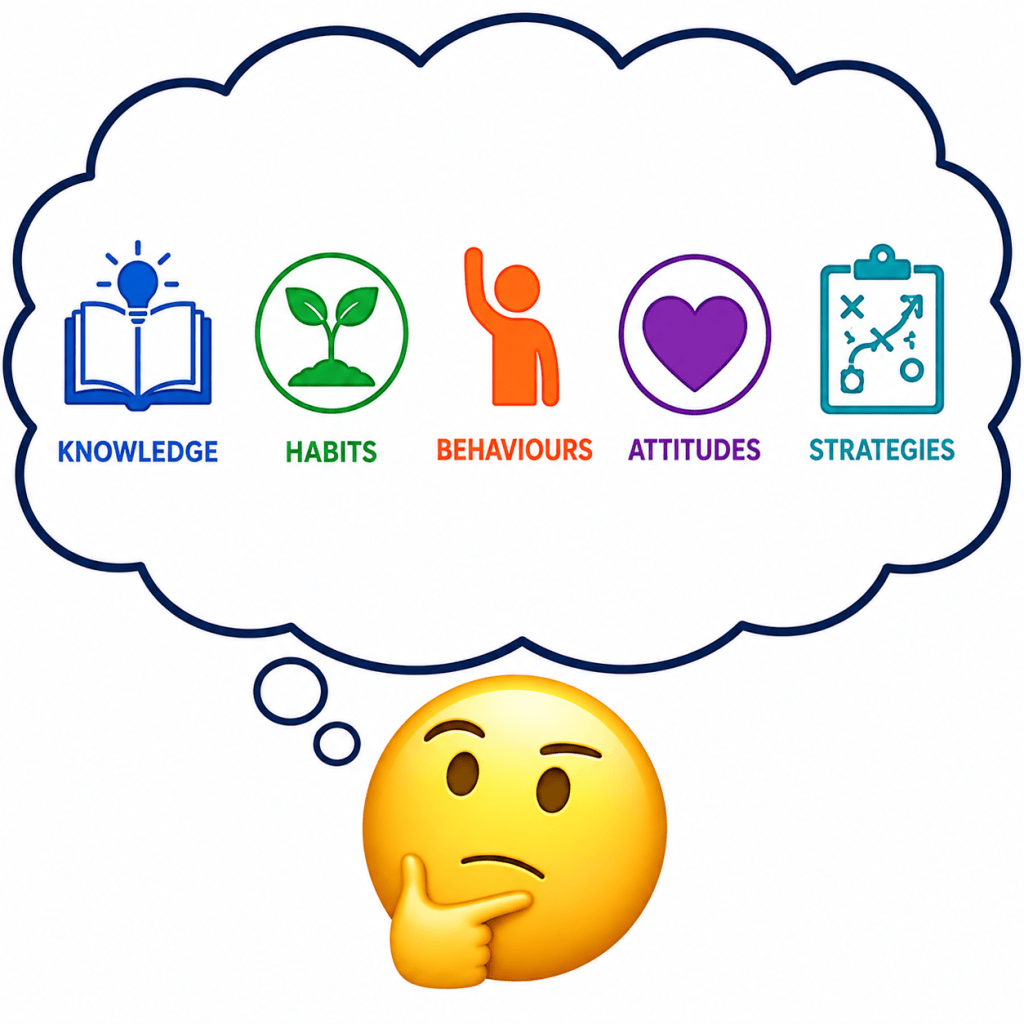
Education has become increasingly concerned with what happens beyond the acquisition of knowledge. Pupils are expected to remember, reason, communicate, collaborate, regulate their behaviour, respond to feedback, solve problems, make decisions and eventually continue learning when formal education has ended. These expectations are not new, yet they raise an important question that is surprisingly difficult to answer:
What does it actually mean for a young person to be ready to learn?
The question matters because schools often work with a collection of related concepts rather than a single coherent understanding. Metacognition, self-regulation, motivation, resilience, behaviour for learning, learner agency, independence, employability and wellbeing all describe important aspects of learner development. Each has a substantial evidence base, yet they are frequently addressed separately.
The concept of Learning Readiness offers a possible way of bringing these strands into conversation. However, contemporary research suggests that the term itself is far from settled. Readiness may refer to preparedness for school entry, online learning, digital learning, mobile learning, adaptive learning or increasingly independent study. The result is a literature that is growing rapidly while remaining conceptually fragmented.
This raises a more fundamental question.
Are we researching readiness for particular forms of learning, or are we beginning to identify the characteristics of a learner who can continue becoming ready for new learning throughout life?
This distinction is central to the proposition developed by Long Game Learning.
Readiness is not a single state
The language of readiness can imply a threshold. A learner is either ready or they are not.
Educational development is rarely that simple.
A pupil may be highly motivated but lack the knowledge needed to understand a new concept. Another may possess strong subject knowledge but struggle to organise independent study. A third may know effective revision strategies but lack the confidence to use them without adult support.
Readiness therefore cannot easily be reduced to one characteristic.
Positive Action’s contemporary discussion of learner readiness provides a useful starting point. It describes readiness in terms of both the ability and willingness to engage, while also connecting readiness with motivation, self-concept and emotional wellbeing (Positive Action, 2025a; 2025b; 2025c). This is valuable because it moves away from viewing readiness as a fixed characteristic that pupils either possess or lack.
It also reflects a broader psychological literature. Self-Determination Theory, for example, emphasises autonomy, competence and relatedness as important psychological conditions associated with motivation and wellbeing (Ryan and Deci, 2000).
Yet willingness and capability are not the same thing.
A learner can want to succeed without knowing how to learn effectively. A pupil can be enthusiastic about revision without possessing an effective strategy for remembering information. A student can be willing to contribute to discussion without possessing the knowledge or communication skills required to make a meaningful contribution.
Motivation is therefore important to readiness, but it cannot reasonably constitute readiness in its entirety.
This distinction provides an important starting point for a broader conception.
From willingness to capability
Research into self-regulated learning offers a useful way of extending the discussion.
Zimmerman (2002) conceptualises self-regulated learning as an active process in which learners set goals, select strategies, monitor their progress and reflect upon their performance. Readiness, from this perspective, involves more than being prepared to participate. It involves developing the capacity to manage learning.
The Education Endowment Foundation’s work on metacognition and self-regulated learning similarly emphasises planning, monitoring and evaluation, alongside explicit teaching and modelling of learning strategies (Muijs and Bokhove, 2020; EEF, 2025).
This matters because strategies can be developed. A learner can initially require considerable teacher modelling to plan a task. With guided practice, they may begin to plan independently. Later, they may select different strategies according to the task and eventually evaluate whether those strategies were effective.
Readiness is therefore potentially developmental. It is not simply a psychological state that changes from one moment to another. It can also represent a capability that becomes increasingly sophisticated through teaching, practice and experience.
That distinction is important to Long Game Learning.
Knowledge belongs within readiness
There is another dimension that is sometimes less visible in discussions of readiness: knowledge itself.
Learners need something with which to think.
Research in the learning sciences has repeatedly demonstrated the importance of prior knowledge in understanding new material and building increasingly sophisticated knowledge structures (National Academies of Sciences, Engineering, and Medicine, 2018).
This creates an important tension in contemporary educational discourse. There is understandable interest in transferable skills, independence and learner agency. However, transferable capability does not make disciplinary knowledge unnecessary. Critical thinking requires knowledge. Problem solving requires knowledge. Communication requires something meaningful to communicate.
Knowledge is therefore both an outcome of learning and a condition that supports subsequent learning. For this reason, the Long Game Learning proposition deliberately includes knowledge within its definition of Learning Readiness.
The proposed definition is:
Learning Readiness is the combination of knowledge, habits, behaviours, attitudes and strategies that enable individuals to learn effectively, over their lifetime.
This is not presented as a discovery that these five elements have previously been absent from educational research. They have not.
The proposition is instead one of synthesis. Long Game Learning brings established strands of research together and asks whether they can be understood as components of a broader developmental capability.
That distinction is crucial.
What recent research tells us
The contemporary literature makes the need for such a distinction particularly clear.
A significant proportion of recent research has examined online or digital learning readiness. Vo, Nguyen and Power (2024), for example, investigated online learning readiness among secondary school students and identified dimensions including technology readiness, learner control, online communication self-efficacy, self-directed learning and motivation.
The significance of this work extends beyond online education. Several of the identified characteristics are relevant to learning more generally.
However, the construct remains tied to a particular learning environment.
The same pattern can be seen in more recent studies. Research has examined mobile learning readiness, online learning readiness in higher education, digital learning readiness and readiness for learning environments incorporating generative AI (Xu, 2025; Ip and To, 2025; Alanoglu, Karabatak and Yang, 2025; Huang and Tseng, 2026).
These studies are valuable because they demonstrate that readiness is multidimensional.
They also reveal a conceptual problem. We increasingly have evidence about what makes someone ready for this learning environment, that technology or this educational context.
What we have less evidence for is a robust, cross-contextual construct describing what enables a learner to approach changing forms of learning effectively.
That is where the Long Game proposition begins.
The digital readiness question
The dominance of digital learning within recent readiness research should not be interpreted as a weakness in the research itself. Digital environments create legitimate and important questions about learner preparedness. The issue is one of conceptual scope.
A learner may need technical competence to participate in an online course. They may need digital literacy to evaluate information. They may need additional strategies to regulate their attention when learning remotely. These are genuine forms of readiness.
However, the underlying capacity to plan, monitor, evaluate, communicate, seek help and adapt strategies may remain relevant when the technology changes. This suggests a distinction between context-specific readiness and underlying learning capability.
Digital readiness can therefore be understood as one manifestation of readiness rather than necessarily being its conceptual foundation. The question for Long Game Learning becomes:
What capabilities should education deliberately develop so that learners can approach different forms of learning throughout their lives?
That is a broader question than whether a pupil is ready to learn online. It is also a more demanding one.
Readiness is not the same as attainment
An important contribution of the more recent literature is the warning against treating readiness as synonymous with learning outcomes.
Raihan et al. (2026), for example, examined the relationship between learning readiness and science conceptual understanding among elementary pupils. The study is particularly useful because it challenges any simplistic assumption that stronger readiness should automatically translate into stronger conceptual understanding.
This distinction matters. A learner can be ready to learn without immediately mastering a difficult concept. Conversely, a pupil can perform highly in a particular assessment without necessarily possessing the habits, strategies or independence needed for future learning.
If readiness is simply defined as whatever predicts attainment, the construct risks becoming circular.
A stronger conception separates the learner’s capacity to engage effectively in learning from the eventual outcome of that learning.
This is one reason the Long Game definition is deliberately framed around the conditions and capabilities that enable learning, rather than around attainment itself.
Learning Readiness sits between preparation and outcome.
It is not the grade.
It is not engagement.
It is not behaviour.
It is not motivation.
It is the developing combination of characteristics that makes increasingly effective learning possible.
The learner does not develop in isolation
There is another important caution.
A focus on learner readiness can unintentionally create a deficit model in which responsibility sits entirely with the child.
Contemporary research challenges this interpretation.
Semerikov et al. (2026), for example, approach readiness from the perspective of the learning environment, developing an assessment framework for adaptive learning within Moodle courses. This illustrates that readiness can also concern whether an environment is sufficiently structured to support learning.
This matters in schools. A pupil who struggles to regulate their learning may require explicit teaching rather than simply being labelled as lacking independence.
A learner who appears disengaged may be experiencing a curriculum that offers insufficient relevance, challenge or belonging.
A student who struggles to apply knowledge may not have been given sufficient opportunities to practise transfer.
Readiness is therefore relational. Learners develop capabilities, but environments shape the opportunities available for those capabilities to develop and be expressed.
This means that a meaningful theory of Learning Readiness must avoid asking only:
Is the learner ready?
It should also ask:
What have we done to make becoming ready possible?
From dynamic readiness to developmental readiness
This leads to a distinction that may be particularly important for future research.
Readiness can be dynamic: it changes according to circumstances.
A learner may feel confident in one environment and uncertain in another. They may be highly self-regulated when working in a familiar subject but dependent upon support when encountering an unfamiliar task.
However, readiness can also be understood as developmental.
Through teaching, practice, experience and reflection, learners may become increasingly capable of managing unfamiliar learning situations.
This is a different proposition.
It suggests that the goal of education should not be to make a pupil permanently “ready”. That would be impossible in a changing world.
Instead, education should develop learners who are increasingly capable of becoming ready.
That is the conceptual move at the heart of Long Game Learning.
Where learner agency enters the argument
The literature on learner agency strengthens this proposition.
Gupta et al. (2024), in a scoping review of learner agency, self-regulated learning and self-directed learning, highlight the relationships between intrapersonal, behavioural and contextual dimensions of agency.
Agency represents something beyond participation. An engaged learner participates in learning. An increasingly agentic learner begins to influence how they approach learning, make decisions about it, respond to challenges and identify what they need next.
This has clear implications for lifelong learning. The capacity required of a primary pupil is not identical to that required of an apprentice or professional. The contexts change. The underlying capability to manage learning, however, may continue to develop.
Arianpoor et al. (2024) provide a particularly relevant recent example through the SELF-ReDiAL framework, which conceptualises self-regulated and self-directed learning as adaptable aptitudes rather than purely context-specific skills.
Their subsequent validation work provides empirical support for a four-factor model comprising inquisitiveness, accomplishment, implementation and independence (Arianpoor et al., 2025).
Although, SELF-ReDiAL does not constitute a theory of Learning Readiness in the broader sense proposed here, it does provide an important conceptual bridge between established work on self-regulation, self-direction and the developing capacity to respond to new learning demands.
This is where the concept of readiness begins to move beyond the school timetable.
What Long Game Learning is actually proposing
At this point, it is important to be precise about the originality of the argument.
Long Game Learning is not claiming to have discovered knowledge, motivation, self-regulation, metacognition, agency, resilience or transferable skills.
The research base for these areas is already substantial. Neither is it claiming that every existing readiness construct describes the same phenomenon. The evidence does not support such a claim.
Instead, Long Game Learning proposes that these bodies of research can be brought together through a developmental conception of Learning Readiness.
The five components of the proposed definition have distinct roles.
Knowledge provides the conceptual and disciplinary foundations upon which new learning can build.
Habits represent repeated patterns of action that increasingly support effective learning.
Behaviours provide observable evidence of how learners enact those habits, attitudes and strategies.
Attitudes encompass dimensions such as motivation, confidence, persistence and openness to challenge.
Strategies describe the deliberate approaches learners use to plan, monitor, evaluate, remember, practise and adapt.
These dimensions should not be treated as five isolated boxes.
They interact.
Knowledge can strengthen confidence. Effective strategy use can increase motivation. Repeated practice can establish habits. Feedback can change strategy selection. Supportive relationships can influence willingness to engage.
Learning Readiness is therefore better understood as an interconnected developmental construct than as a checklist of desirable learner characteristics.
Ready. Set. Life. as an applied architecture
If Learning Readiness is the theoretical proposition, Ready. Set. Life. is the architecture through which Long Game Learning proposes that schools could organise its development.
The three pillars are not intended to represent year groups or departments. They are lenses through which educational decisions can be considered.
READY: establishing the foundations
READY focuses on the conditions and capabilities required for effective learning.
This includes curriculum coherence, knowledge, literacy, numeracy, executive function, self-regulation, metacognition, retrieval, memory, learning routines, inclusion, belonging and wellbeing.
The underlying question is:
Are we deliberately developing the foundations pupils need to learn effectively?
This changes the role of learning strategies.
Instead of assuming that pupils know how to revise, plan, retrieve or monitor their understanding, schools can explicitly teach these processes.
The curriculum audit developed alongside the framework reflects this principle through questions concerning curriculum ambition, knowledge sequencing, assessment, identification of knowledge gaps and preparation for the next stage of learning.
READY is therefore not simply about whether the curriculum contains sufficient knowledge.
It asks whether the curriculum is designed in a way that helps learners become increasingly capable of accessing, organising and using that knowledge.
SET: applying what has been learned
SET addresses what happens when learners begin to use their knowledge and capabilities beyond the immediate learning situation.
Its focus includes communication, problem solving, collaboration, creativity, leadership, transfer, careers, enrichment, employability and digital literacy.
The central question becomes:
Can pupils apply what they know with increasing independence in unfamiliar contexts?
This matters because knowledge does not automatically transfer.
Learners need opportunities to practise using knowledge and strategies in different situations. They need to explain their thinking, make decisions, solve problems and reflect upon the effectiveness of their approach.
This is also where a shared language becomes significant.
If pupils encounter the language of planning, reflection, communication, problem solving or evaluation only in isolated lessons, the possibility of transfer is weakened. A consistent vocabulary across curriculum, pastoral provision, careers and enrichment may help learners recognise that the same broad capabilities can be used differently across contexts.
The claim here is not that every subject should teach generic skills in the same way.
Rather, the proposition is that learners should be able to recognise the underlying capability while understanding that its disciplinary application changes.
LIFE: extending learning beyond formal education
LIFE represents the longest-term element of the framework.
Its concern is not simply whether pupils achieve academically, but whether they can use their developing capabilities to navigate future learning, work, relationships, wellbeing, identity, aspiration and change.
The question becomes:
Are we preparing young people to continue learning and adapting after formal education?
This connects the framework with wider thinking about learner agency and lifelong learning.
The proposed learning continuum therefore does not treat transition as a series of resets. Instead, primary, secondary, further education, higher education, apprenticeships and employment become stages in an ongoing developmental process. The framework materials explicitly position the learner journey as cumulative, with the same broad language and expectations developing in sophistication over time.
This is an important distinction.
The goal is not to produce a pupil who is “ready for secondary school”, followed by another intervention to make them “ready for university”, followed by another to make them “work ready”.
The longer-term ambition is to develop someone who becomes increasingly capable of adapting to whatever learning comes next.
Why this matters for schools
This proposition has practical implications because it changes the question schools ask about learner development.
Instead of:
Is this pupil ready?
the question becomes:
What are we deliberately doing to develop this pupil’s readiness?
That is a shift from classification to development.
A pupil struggling with revision should prompt questions about whether effective revision strategies have been explicitly taught.
A pupil reluctant to communicate may need structured opportunities to practise communication in different settings.
A pupil who depends heavily on adult prompting may need carefully graduated opportunities to assume responsibility.
A pupil who lacks confidence may need meaningful experiences of challenge, success and reflection.
The important point is that these are not simply problems located within the learner.
They are also questions about curriculum, pedagogy, environment and opportunity.
Learning Readiness therefore becomes something education can seek to develop, rather than simply something it attempts to measure.
The unresolved question: does it transfer?
There is, however, a significant empirical question that the current literature does not answer.
If a learner develops an effective strategy in one context, do they recognise when that strategy is relevant somewhere else?
A pupil may know how to plan a science investigation but struggle to plan revision.
A student may communicate effectively within a classroom but find professional communication unfamiliar.
An apprentice may be able to respond to feedback in a practical task but struggle to apply the same reflective process to their wider professional development.
Transfer cannot therefore be assumed.
This is one of the areas where the Long Game proposition requires research rather than assertion.
If Learning Readiness is genuinely cross-contextual, stronger evidence should eventually demonstrate that some underlying capabilities remain identifiable as learners move between subjects, phases and environments.
That is a testable proposition.
What should happen next?
The next stage for Learning Readiness should therefore be empirical rather than rhetorical.
Several questions deserve investigation.
First, can knowledge, habits, behaviours, attitudes and strategies be distinguished sufficiently to form meaningful dimensions of a broader construct?
Second, does Learning Readiness develop longitudinally across educational phases?
Third, which dimensions are most strongly associated with increasing learner independence?
Fourth, can capabilities developed in one context be transferred to another?
Fifth, how should readiness be distinguished from engagement, attainment, behaviour and motivation?
Sixth, what role does the learning environment play in enabling readiness to develop?
Finally, can a whole-school architecture such as Ready. Set. Life. improve coherence across curriculum, teaching, inclusion, personal development, careers and enrichment?
These questions are more important than simply demonstrating that the framework “works”.
They concern whether the underlying construct itself is conceptually valid.
A proposition, not a conclusion
This is perhaps the most important point to make about Long Game Learning.
The evidence reviewed across the existing literature provides substantial support for the importance of the component parts of Learning Readiness. Motivation matters. Prior knowledge matters. Self-regulation matters. Metacognition matters. Agency matters. Context matters.
What the literature has not yet established is that these elements constitute a single, empirically validated, cross-contextual construct called Learning Readiness in the sense proposed here.
That remains a proposition.
This should not weaken the argument.
It strengthens it.
Academic integrity requires a clear distinction between evidence and interpretation, between established theory and new synthesis, and between an evidence-informed framework and an empirically validated intervention.
Long Game Learning can therefore make a more modest, but potentially more valuable, claim.
It proposes that Learning Readiness provides a useful organising concept through which established research on how learners learn, regulate, apply and continue learning can be brought into a coherent developmental architecture.
In this sense, Learning Readiness is defined as:
The combination of knowledge, habits, behaviours, attitudes and strategies that enable individuals to learn effectively, over their lifetime.
This definition is intentionally integrative. It brings together what the literature often treats separately: the knowledge learners draw upon, the habits they develop through repetition, the behaviours they demonstrate in context, the attitudes that shape engagement and persistence, and the strategies they use to plan, monitor, evaluate and adapt their learning.
Ready. Set. Life. then provides one possible way of translating that proposition into educational practice.
The framework begins with the foundations required to learn effectively.
It moves towards the capacity to apply learning.
It ultimately asks whether those capabilities remain useful when the learner leaves the structures of formal schooling.
The long-term proposition is therefore not that education can make young people permanently ready.
It is that education can help them become increasingly capable of getting ready for what they need to learn next.
That may be the more useful definition of readiness for an uncertain educational and working world.
And it changes the purpose of the question entirely.
We stop asking whether young people are ready.
We start asking whether we are giving them the knowledge, habits, behaviours, attitudes and strategies to keep becoming ready.
That is the question Long Game Learning now places at the centre of its work.
References
Alanoglu, M., Karabatak, S. and Yang, H. (2025) ‘Understanding university students’ self-directed online learning in the context of emergency remote teaching: the role of online learning readiness and digital literacy’, Journal of Computing in Higher Education, 38, pp. 651–677.
Arianpoor, A., Taylor, S.C.R., Huang, P.-H. and Shulruf, B. (2024) ‘Enablers of and barriers to self-regulated and self-directed aptitudes of learning (SELF-ReDiAL) in health professional education: a systematic review and meta-analysis’, Medical Science Educator, 34, pp. 1193–1202.
Arianpoor, A., Taylor, S.C.R., Huang, P.-H. and Shulruf, B. (2025) ‘Development and validation of a measure of self-regulated and self-directed aptitudes of learning (SELF-ReDiAL) in health professional education’, Medical Science Educator.
Chou, C., Hung, M.-L. and Li, Z.R.-Y. (2026) ‘Revisiting online learning readiness: scale development and insights from Taiwanese elementary school students’, Educational Technology & Society, 29(3), pp. 51–63.
Education Endowment Foundation (2025) Metacognition and Self-Regulated Learning: Guidance Report. 2nd edn. London: Education Endowment Foundation.
Gupta, N., Ali, K., Jiang, D., Fink, T. and Du, X. (2024) ‘Beyond autonomy: unpacking self-regulated and self-directed learning through the lens of learner agency: a scoping review’, BMC Medical Education, 24, 1519.
Huang, T.-C. and Tseng, H.-P. (2026) ‘Development and psychometric evaluation of the GAI-assisted programming learning readiness scale for university students: a dual-theory approach integrating Social Cognitive Theory and Self-Determination Theory’, European Journal of Education, 61(3),
Ip, S.W.S. and To, W.-M. (2025) ‘Effects of online learning readiness and online self-regulated English learning on satisfaction with online English learning experience during the COVID-19 pandemic’, Behavioral Sciences, 15(1), 93.
Muijs, D. and Bokhove, C. (2020) Metacognition and Self-Regulation: Evidence Review. London: Education Endowment Foundation.
National Academies of Sciences, Engineering, and Medicine (2018) How People Learn II: Learners, Contexts, and Cultures. Washington, DC: National Academies Press.
Polat, M. (2024) ‘Readiness, resilience, and engagement: analyzing the core building blocks of online education’, Education and Information Technologies, 29, pp. 1–28.
Positive Action (2025a) ‘What is learner readiness and why it matters’, Positive Action, 20 May, updated 19 November 2025.
Positive Action (2025b) Learning Readiness Program. Positive Action.
Positive Action (2025c) ‘Learning readiness and mental health’, Positive Action, 15 August 2025.
Raihan, P.D., Hastuti, W.S., Mustadi, A., Munfariqoh, A., Rizal, A.S., Setyoningsih, R.U. and Setiani, H. (2026) ‘When learning readiness fails to predict science conceptual understanding: structural evidence from elementary education in the Society 5.0 era’, Journal of Education Culture and Society, 17(1), pp. 351–375.
Ryan, R.M. and Deci, E.L. (2000) ‘Self-determination theory and the facilitation of intrinsic motivation, social development, and well-being’, American Psychologist, 55(1), pp. 68–78.
Semerikov, S., Nechypurenko, P., Vakaliuk, T., Mintii, I. and Fadieieva, L. (2026) ‘Development and validation of an adaptive learning readiness assessment framework for Moodle courses’, Journal of New Approaches in Educational Research, 15, 19.
Siko, J.P., Barbour, M.K., Wilson, E.V. and Adelstein, D. (2026) ‘Assessing and improving digital learning readiness: a review and roadmap for future research’, Journal of Online Learning Research, 12(1), pp. 151–168.
Vo, D.V., Nguyen, P.N.T. and Power, J. (2024) ‘Online learning readiness in secondary education: validating the Online Learning Readiness Scale and examining the impact role of ICT familiarity’, Journal of E-Learning and Knowledge Society, 20(2), pp. 1–8.
Xu, X. (2025) ‘Mobile learning readiness: an integrative theoretical perspective’, Discover Education, 4, 136.
Zimmerman, B.J. (2002) ‘Becoming a self-regulated learner: an overview’, Theory Into Practice, 41(2), pp. 64–70.


Leave a Reply