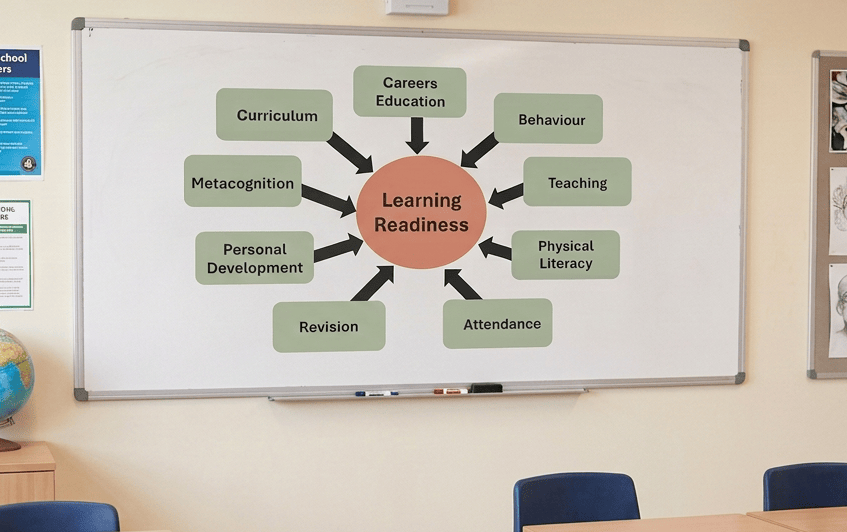
If you ask ten educators what makes a pupil ready to learn, you are likely to receive ten different answers.
Some will talk about behaviour. Others will focus on attendance, wellbeing or motivation. Some will point towards prior knowledge, while others will argue that effective learning depends upon metacognition, self-regulation or executive function. Each perspective is supported by research, yet none tells the whole story.
What does Learning Readiness mean?
Schools have never known more about how children learn.
Research into cognitive science, curriculum design, metacognition, self-regulation, motivation and memory has transformed our understanding of effective teaching. At the same time, schools continue to invest significant time and resources into improving behaviour, attendance, personal development, inclusion and curriculum implementation.
Yet these priorities are often treated as separate conversations.
Behaviour is discussed through one policy. Attendance through another. Curriculum through subject planning. Revision through intervention programmes. Personal development through statutory provision. Each matters, each is supported by evidence, and each contributes to pupil success. But too often they exist alongside one another rather than as part of a coherent strategy.
Learning Readiness provides the thread that connects them.
At Long Game Learning, we define Learning Readiness as the combination of knowledge, habits, behaviours, attitudes and strategies that enable pupils to learn effectively. It is not an intervention, a programme or a new initiative. It is the condition that allows learning to happen.
This distinction is important because Learning Readiness is not about adding something new to an already crowded school improvement plan. It is about recognising that every decision a school makes either strengthens or weakens pupils’ capacity to learn. A carefully sequenced curriculum, consistent classroom routines, effective teaching, strong attendance, purposeful behaviour, meaningful personal development and high-quality careers education all contribute to the same long-term goal: developing learners who know how to learn, understand why learning matters and can apply that learning with increasing independence.
Although the phrase Learning Readiness appears throughout educational research, it is often used to describe different things. Developmental psychologists may use it when discussing children’s readiness to begin school. Cognitive scientists focus on the mental processes that support learning. School improvement literature often refers to behaviour, engagement or attitudes to learning, whilst research into self-regulation explores how pupils plan, monitor and evaluate their own progress.
Each perspective is valuable, but none provides the whole picture.
Long Game Learning brings these complementary strands together into one coherent framework that schools can apply strategically. Rather than asking how to improve curriculum, attendance, behaviour or revision in isolation, Learning Readiness encourages leaders to ask a different question.
Does this help pupils become better learners?
That single question changes the conversation. It shifts the focus away from isolated initiatives and towards creating the conditions in which every pupil can learn, grow and thrive over the long term.
Why the Term Gets Used So Differently
Although the phrase Learning Readiness appears throughout educational research, it has never settled on a single definition. Developmental psychologists often use it to describe whether young children are prepared to begin formal education. Cognitive scientists explore the mental processes that underpin successful learning, including attention, memory and cognitive load. Educational researchers examine metacognition, self-regulation and executive function, while school improvement literature frequently focuses on behaviour, engagement or attitudes to learning.
Each perspective is valuable because each explains part of what enables pupils to learn successfully.
The challenge for schools is that these ideas often remain confined to their own research fields or improvement priorities. A leader reading about attendance may encounter different language from someone exploring curriculum design or cognitive science, even though all are ultimately concerned with improving pupils’ capacity to learn.
This has unintentionally created a fragmented conversation. Schools have become increasingly evidence-informed, but the evidence itself is often organised into separate domains rather than a coherent whole.
Learning Readiness provides that coherence.
Rather than replacing existing research, it offers a way of bringing those complementary ideas together into a single framework that leaders, teachers and parents can understand and apply consistently.
One Framework, One Question
Long Game Learning does not present Learning Readiness as a new theory. Nor does it claim to replace the extensive body of evidence that already exists. Instead, it synthesises what we know about effective learning into one practical framework that schools can use to guide improvement.
Viewed through this lens, curriculum, behaviour, attendance, metacognition, revision, personal development and careers education are no longer isolated priorities. They become interconnected parts of the same ambition: developing pupils who know how to learn, understand why learning matters and can apply that learning with increasing independence.
This changes the conversation.
Rather than asking which initiative should come next, leaders can begin with a much simpler question.
Does this help pupils become better learners?
That question is deliberately broad because it applies at every level of school improvement. It shapes strategic decisions made by trust leaders, curriculum planning undertaken by middle leaders, classroom practice developed by teachers and the conversations parents have with their children at home.
When every decision is viewed through the lens of Learning Readiness, improvement becomes more coherent, more sustainable and more closely aligned to the long-term purpose of education.
What the Evidence shows
This understanding has developed not only through research, but through my own experience leading curriculum development and school improvement across primary and secondary education.
Whether redesigning physical education curricula around transferable concepts, leading whole-school careers strategy, developing enrichment programmes or reviewing curriculum implementation, the same pattern repeatedly emerged. Pupils rarely struggled because schools lacked ambition or expertise. More often, they struggled because they had not yet developed the habits, strategies and confidence needed to engage successfully with increasingly demanding learning.
This became particularly apparent when reviewing curriculum implementation. Well-sequenced curricula, clear teaching and carefully planned assessment all improved learning, but their impact depended upon pupils being able to access them effectively. Those who understood how to organise their learning, regulate their attention, retrieve prior knowledge and reflect on their progress consistently made stronger gains over time.
Curriculum remains fundamental, but curriculum alone cannot guarantee success.
A carefully sequenced curriculum has limited impact if pupils struggle to sustain attention, manage cognitive demand or recognise which learning strategies are most effective. Likewise, excellent teaching becomes even more powerful when pupils understand how memory works, know how to revise effectively and can monitor their own progress independently.
This is why Learning Readiness should not be viewed as something separate from curriculum. It is the foundation that allows curriculum to achieve its intended impact.
What the Research says
The research supporting Learning Readiness is extensive, even if the terminology differs across disciplines.
The Education Endowment Foundation identifies metacognition and self-regulated learning as among the highest impact, lowest cost approaches available to schools because they help pupils plan, monitor and evaluate their own learning. Cognitive science continues to demonstrate that learning depends upon successfully moving information through attention, working memory and long-term memory, making retrieval practice, carefully sequenced instruction and appropriately managed cognitive load essential features of effective teaching.
Research into executive function highlights the importance of planning, organisation, flexible thinking and self-control, whilst motivation research consistently demonstrates that learners are more likely to flourish when they experience competence, autonomy and a genuine sense of belonging.
Individually, these are distinct areas of educational research.
Collectively, they describe the conditions that enable learning to take place.
That is why Long Game Learning uses the term Learning Readiness. It provides a practical, strategic way of bringing these complementary fields together without losing the richness of the evidence that underpins them.
What this changes in practice
Viewing schools through the lens of Learning Readiness changes far more than classroom practice. It changes how improvement itself is understood.
Attendance is no longer simply about being present. It is about ensuring pupils are available, physically and mentally, to engage with learning.
Behaviour is no longer viewed solely as classroom management. It creates the conditions in which attention, participation and sustained thinking can flourish.
Revision becomes more than preparation for examinations. It becomes an opportunity to teach pupils how memory works, helping them develop independent learning habits that extend far beyond a single assessment.
Careers education becomes more than exploring future pathways. It helps pupils understand why learning matters, strengthening motivation by connecting today’s curriculum with tomorrow’s opportunities.
Personal development becomes more than a statutory entitlement. It develops confidence, resilience, self-regulation and identity, all of which contribute directly to successful learning.
Even curriculum design takes on a broader purpose. Rather than asking only what pupils should know, schools begin asking whether the curriculum is also helping pupils become increasingly capable learners.
Learning Readiness provides the common thread that allows these priorities to reinforce one another instead of competing for time, attention and resources. Rather than introducing another initiative, it offers schools a coherent way of understanding how existing priorities work together to create the conditions in which every pupil can learn, grow and thrive.
What This Means for Teachers, Leaders and Parents
Learning Readiness is not a responsibility that sits with one person or one department. It is shaped by every interaction a young person has with school. Teachers develop it through everyday classroom practice. Leaders strengthen it through strategic decision-making. Parents reinforce it through the conversations and routines they create at home.
When everyone understands what Learning Readiness is and why it matters, pupils experience greater consistency. They encounter the same expectations, the same language and the same understanding of what successful learning looks like, regardless of the classroom, subject or stage of education.
For Teachers
Every lesson presents an opportunity to strengthen Learning Readiness alongside subject knowledge.
Effective teachers do more than deliver curriculum content. They explicitly model how to approach unfamiliar problems, encourage pupils to reflect on their learning, revisit prior knowledge and build confidence through carefully structured success. These small, deliberate actions help pupils become increasingly independent learners rather than passive recipients of information.
This does not require a new programme or additional workload. It begins by making the learning process visible, helping pupils understand not only what they are learning, but how they are learning it.
For School Leaders
For leaders, Learning Readiness provides a strategic lens through which improvement becomes more coherent.
Rather than viewing curriculum, attendance, behaviour, inclusion, personal development and careers education as separate priorities, leaders can ask how each contributes to developing better learners. This creates greater alignment across policies, professional development and school improvement planning, reducing initiative overload whilst strengthening the impact of existing practice.
Most importantly, it keeps the long-term purpose of education at the centre of every decision. Schools are not simply preparing pupils for the next assessment. They are preparing them to become confident, adaptable and independent learners who continue to grow long after they leave the classroom.
For Parents
Parents play a vital role in developing Learning Readiness because many of the habits that support successful learning are strengthened beyond the school day.
Simple conversations can make a significant difference. Rather than asking, “Have you finished your homework?” or “Have you revised?”, parents might instead ask, “How did you revise?”, “What strategy helped you remember?” or “What will you try differently next time?”
These questions encourage children to think about the learning process itself, helping them develop the self-awareness and independence that underpin lifelong learning.
The Ready. Set. Life. Framework
Learning Readiness sits at the heart of the Ready. Set. Life. framework because it provides the foundations upon which every other aspect of education is built.
The first stage, Ready, focuses on developing the knowledge, routines, self-regulation and learning strategies that enable pupils to access the curriculum with confidence. Without these foundations, even the strongest curriculum cannot achieve its full potential.
Once pupils are ready to learn, they move into Set, where they begin applying their knowledge in increasingly authentic contexts. Here, learning extends beyond remembering information to communicating ideas, solving problems, collaborating with others and developing the confidence to transfer learning across subjects and situations.
Finally, Life focuses on preparing young people to thrive beyond school. Academic success remains important, but it is viewed alongside character, aspiration, wellbeing, employability and lifelong learning. The goal is not simply to produce successful pupils, but capable adults who continue learning throughout their lives.
Learning Readiness is therefore more than the first stage of the framework. It is the thread that connects every stage of a young person’s educational journey, from their earliest experiences of school through to further education, employment and adulthood.
Importantly, Learning Readiness is not something pupils either possess or lack. It can be deliberately developed. Just as schools explicitly teach subject knowledge, they can explicitly teach the habits, routines, strategies and behaviours that enable pupils to become increasingly effective learners.
What’s next in this Collection?
This article introduces the umbrella concept of Learning Readiness. The rest of the Cornerstone Collection explores how it shapes every aspect of school improvement.
The articles in this collection examine:
- Learning Readiness and Curriculum Design – Why curriculum should develop learners as well as knowledge.
- Learning Readiness and Attendance – Why attendance is about access to learning, not simply presence.
- Learning Readiness and Behaviour – Creating the conditions in which learning can flourish.
- Learning Readiness and Metacognition – Helping pupils understand how learning works.
- Learning Readiness and Self-Regulated Learning – Developing independent, reflective learners.
- Learning Readiness and Revision – Teaching pupils how to remember, retrieve and apply knowledge effectively.
- Learning Readiness and Personal Development – Building confidence, resilience and belonging.
- Learning Readiness and Careers Education – Connecting learning with future aspirations and opportunities.
Together, these articles present Learning Readiness not as another educational initiative, but as a coherent framework for developing better learners and creating more connected, sustainable school improvement.
Frequently Asked Questions
Is Learning Readiness the same as School Readiness?
Not quite.
School readiness usually describes the knowledge, skills and developmental milestones children need before starting formal education. Learning Readiness applies throughout a young person’s educational journey. It focuses on the habits, strategies, behaviours and attitudes that enable pupils of any age to learn effectively, whether they are beginning Reception, choosing GCSE options or preparing for employment.
How is Learning Readiness different from behaviour for learning?
Behaviour for learning is one important part of Learning Readiness, but it is not the whole picture.
Positive behaviour creates the conditions in which learning can happen by reducing disruption and supporting engagement. Learning Readiness goes further by encompassing the knowledge, self-regulation, metacognitive strategies, motivation and learning habits pupils need once those conditions are in place.
How can teachers start developing Learning Readiness in the classroom?
The most effective approach is to begin with small, consistent routines rather than introducing something entirely new.
Encourage pupils to plan before they begin a task, monitor their progress whilst working and reflect afterwards on what helped them succeed or where they became stuck. Questions such as “What will you do if you get stuck?”, “Which strategy are you going to use?” and “What worked well today?” help make thinking visible and develop the metacognitive habits highlighted within the Education Endowment Foundation’s guidance on self-regulated learning.
Over time, these small routines help pupils become increasingly independent learners who understand not only what they are learning, but how they learn most effectively.
References
Deci, E. L., & Ryan, R. M. (2000). The “What” and “Why” of Goal Pursuits: Human Needs and the Self-Determination of Behaviour. Taylor & Francis. https://www.tandfonline.com/doi/abs/10.1207/S15327965PLI1104_01
Education Endowment Foundation. (2021, updated 2024). Metacognition and Self-Regulated Learning Guidance Report. https://educationendowmentfoundation.org.uk/education-evidence/guidance-reports/metacognition
Education Endowment Foundation. (2024). Teaching and Learning Toolkit. https://educationendowmentfoundation.org.uk/education-evidence/teaching-learning-toolkit
Gathercole, S. E., & Alloway, T. P. (2008). Working Memory and Learning. SAGE Publications.
Ofsted. (2025). Education Inspection Framework. https://www.gov.uk/government/collections/education-inspection-framework
Sweller, J., Ayres, P., & Kalyuga, S. (2011). Cognitive Load Theory. Springer. https://link.springer.com/book/10.1007/978-1-4419-8126-4
Zimmerman, B. J. (2002). Becoming a Self-Regulated Learner: An Overview. Theory Into Practice. Taylor & Francis. https://www.tandfonline.com/doi/abs/10.1207/s15430421tip4102_2


Leave a Reply