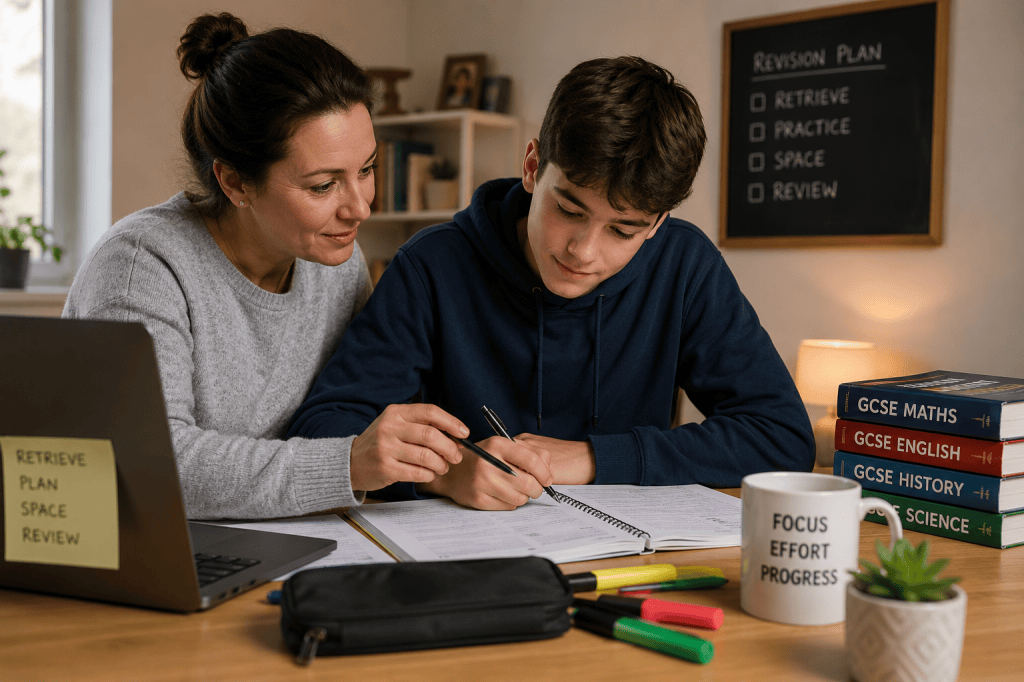
Schools have embraced the science of learning. The next opportunity is helping parents do the same.
Walk into almost any school today and you’ll hear conversations about retrieval practice, cognitive load, metacognition and self-regulation.
Over the last decade, educational research has transformed classroom practice. Teachers are increasingly drawing on evidence from cognitive science to help pupils learn more effectively, remember more over time and become increasingly independent.
Yet there remains one group who are often left out of this conversation.
Parents.
Schools work incredibly hard to build evidence-informed classrooms, but many families are still supporting learning using advice based on tradition rather than research.
“Read your notes again.”
“Spend another hour revising.”
“Just keep going until you’ve finished.”
These suggestions are well intentioned. They come from parents who desperately want their children to succeed.
The problem is that learning doesn’t always work that way.
At Long Game Learning, we believe one of the greatest untapped opportunities for school improvement is helping parents understand the science of learning. Not because we expect them to become teachers, but because they are one of the most influential people in a child’s learning journey.
If schools and families shared the same understanding of how learning happens, the impact could extend far beyond homework. It could transform confidence, independence, wellbeing and ultimately outcomes.
The evidence is remarkably consistent
Although educational research continues to evolve, one message has remained consistent across decades of cognitive science.
Learning is not determined by how long pupils study.
It is determined by what they do while they are studying.
Research by Roediger and Karpicke demonstrated that retrieval practice, actively recalling information from memory, produces significantly stronger long-term retention than simply rereading notes. Every time a pupil has to retrieve information, the memory becomes easier to access in the future.
For many parents, this is a revelation.
The question changes from:
“Have you done your revision?”
to:
“How did you practise remembering it?”
It is a small shift in language, but a profound shift in thinking.
What does the research actually tell us?
One of the reasons learning science has become central to school improvement is that the evidence is remarkably consistent. While researchers continue to refine our understanding of how children learn, several principles appear repeatedly across decades of educational and cognitive science.
Retrieval beats rereading. Research by Roediger and Karpicke found that actively recalling information from memory strengthens long-term retention far more effectively than repeatedly reading notes. Learning happens when pupils have to think hard about what they know, not simply look at it again.
Spacing beats cramming. Cepeda and colleagues demonstrated that revisiting learning over time leads to greater retention than leaving revision until the last minute. Small, regular opportunities to retrieve knowledge are far more effective than long revision sessions completed in a single evening.
Productive struggle strengthens learning. Bjork’s work on desirable difficulties reminds us that effective learning often feels more challenging than ineffective learning. Children may believe they are learning more when revision feels easy, but the opposite is often true. The strategies that require greater mental effort frequently produce the strongest and most durable memories.
Thinking about learning improves learning. The Education Endowment Foundation identifies metacognition and self-regulation as approaches associated with consistently positive gains when implemented well. Encouraging pupils to plan, monitor and evaluate their own learning helps them become increasingly independent over time.
Not all revision strategies are equally effective. Dunlosky and colleagues reviewed the evidence behind the most common study techniques and concluded that practices such as retrieval and spaced learning consistently outperform familiar approaches like highlighting, rereading and copying notes.
Forgetting isn’t failure
Perhaps one of the most reassuring findings from learning science comes from Hermann Ebbinghaus’ work on memory. His research showed that forgetting is normal. In fact, it is expected.
Children often assume that forgetting means they are bad at a subject. Parents understandably worry when their child cannot remember something they seemed to know last week.
Learning science tells us something different. Forgetting is part of learning. The goal is not to avoid forgetting altogether. The goal is to interrupt it through regular retrieval over time.
When families understand this, frustration gives way to patience.
Instead of seeing revision as repeatedly reading information, children begin strengthening memory through purposeful practice.
Why cramming rarely works
Every school has seen it.
Exercise books suddenly appear the night before an assessment.
Highlighters come out.
Revision begins in earnest.
The intention is good, but the science tells a different story.
Research by Cepeda and colleagues demonstrates that spaced practice, revisiting learning over days and weeks, consistently outperforms massed practice or cramming.
This presents an important opportunity for school leaders.
Schools invest enormous time carefully sequencing curriculum over months and years. Parents can either reinforce that carefully planned sequence through regular, low-stakes retrieval or unintentionally undermine it by encouraging last-minute revision.
Helping families understand spacing is not simply about improving revision.
It is about extending good curriculum design beyond the classroom.
Parents don’t need to know the curriculum. They need to understand learning.
One of the biggest barriers to parental engagement is confidence.
Many parents worry they cannot help because they no longer remember GCSE maths, Shakespeare or balancing chemical equations.
Fortunately, effective support has very little to do with subject expertise.
The Education Endowment Foundation identifies metacognition and self-regulation as among the highest-impact, most cost-effective approaches for improving pupil outcomes.
These approaches are not about knowing the answers.
They are about helping pupils think about their own learning.
Questions such as:
- What strategy helped you remember that?
- Which topic feels least secure?
- What will you revisit tomorrow?
- What will you do differently next time?
develop independence far more effectively than asking whether homework has simply been completed.
Parents become coaches rather than supervisors.
Children become learners rather than task completers.
Understanding executive function changes everything
Many behaviours that frustrate parents are often misunderstood.
Procrastination.
Poor organisation.
Forgetting equipment.
Leaving revision until the last minute.
These are frequently interpreted as laziness or lack of motivation.
Learning science offers another perspective.
Executive function, our ability to plan, organise, prioritise, monitor attention and regulate behaviour, develops gradually throughout childhood and adolescence. Therefore, consistent routines reduce the demands placed on working memory, allowing pupils to devote more of their cognitive resources to learning.
Many young people need these skills to be taught explicitly:
- Simple routines matter because they reduce cognitive load.
- Breaking tasks into manageable steps.
- Planning revision in advance.
- Removing distractions.
- Establishing consistent study habits.
These are not merely organisational techniques.
They are evidence-informed strategies that support learning.
Why this matters for school leaders
Schools have invested heavily in evidence-informed teaching.
Instructional coaching. Curriculum development. Professional learning. Assessment design.
These investments are making a difference, but pupils spend far more time outside school than inside it. Imagine if every family understood just a handful of evidence-informed principles.
- That forgetting is normal.
- That retrieval strengthens memory.
- That spacing beats cramming.
- That mistakes are valuable.
- That routines support executive function.
- That asking “How did you learn that?” is more powerful than asking “Have you finished?”
Suddenly, learning becomes consistent across school and home and Parents stop feeling like they have to teach the curriculum. Instead, they reinforce the habits that help children learn.
This is why READY comes first
At Long Game Learning, our Ready. Set. Life. framework begins with one simple question:
Are we explicitly teaching children how to learn?
READY is about building the foundations that every learner needs.
- Memory.
- Attention.
- Executive function.
- Metacognition.
- Self-regulation.
- Belonging.
- Wellbeing.
These are not additional initiatives.
They are the conditions that allow every other aspect of education to succeed.
Once pupils understand how learning works, they are ready to apply those habits independently. That is the focus of SET.
Over time, these learning habits become lifelong capabilities that prepare young people to thrive beyond school. That is LIFE.
The framework is built upon decades of research into self-regulated learning, executive function, motivation and cognitive science because better outcomes are rarely the result of a single intervention.
They emerge from a culture where everyone understands how learning happens.
From revision to self-regulation
This philosophy sits at the heart of our Calm Revision Toolkit.
We didn’t create another revision booklet filled with templates.
We created a resource that helps families understand why particular strategies work and how they can build calm, sustainable routines at home.
Because revision should never be about creating more pressure.
It should be about creating better learners.
Why this matters beyond revision
Learning science is too often viewed as something that matters only before examinations.
In reality, it shapes every stage of a young person’s educational journey.
When pupils understand how memory works, they become more resilient when they forget something because they recognise that forgetting is part of learning, not evidence that they cannot succeed.
When parents understand executive function and self-regulation, homework becomes less about enforcing compliance and more about building routines, independence and confidence.
When teachers and families use the same language about learning, pupils experience greater consistency between home and school. Expectations become clearer, conversations become more purposeful and children are encouraged to take increasing ownership of their learning.
This is why learning science sits at the heart of the READY pillar within the Ready. Set. Life. framework. Before pupils can apply knowledge with confidence or prepare for life beyond school, they first need to understand how learning happens.
From there, they begin to transfer these habits into new situations through SET, developing the confidence to plan, monitor and adapt their own learning. Over time, these capabilities become lifelong habits that support further study, employment and personal growth through LIFE.
Learning science is not simply a revision strategy.
It is the foundation of a culture where pupils become increasingly capable, increasingly independent and increasingly prepared for whatever comes next.
That is the long game.
The opportunity ahead
Schools often ask how they can increase parental engagement.
Perhaps the better question is this.
How can we help parents become evidence-informed partners in learning?
When schools and families share the same understanding of how children learn, something powerful happens.
Homework becomes more purposeful.
Revision becomes calmer.
Confidence grows.
Independence develops.
Children become increasingly capable of managing their own learning.
Academic outcomes improve, not because pressure increases, but because learning becomes more effective.
At Long Game Learning, we believe that the long game is:
Not simply better revision.
Not simply better examination results.
but instead is…
Better learners.
Better school cultures.
Better lives.


Leave a Reply